
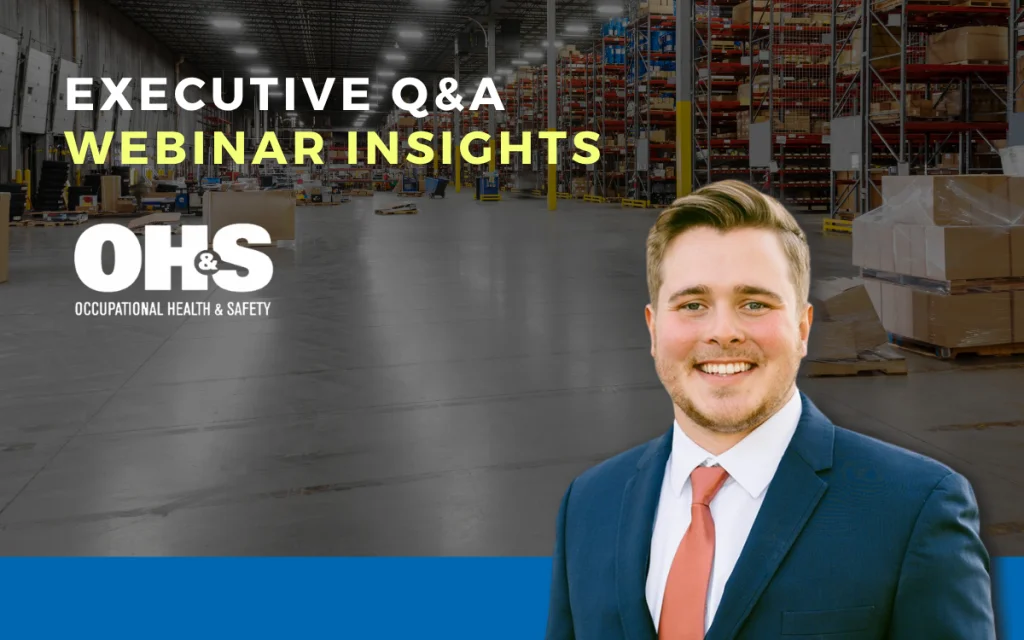
Matrix Design Group’s Jackson Phillips delivered an executive-level webinar in partnership with Occupational Health & Safety (OH&S), addressing one of the most persistent challenges in industrial environments: forklift and pedestrian safety. In the session, “Transforming Forklift Safety Through AI-Powered Collision Avoidance,” Phillips outlined how advances in artificial intelligence are reshaping how organizations approach risk, moving beyond traditional reactive safety measures toward predictive, data-driven strategies.
Watch the full webinar:
Transforming Forklift Safety with AI – Executive Q&A
View the official OH&S webinar page:
Executive Q&A: Transforming Forklift Safety Through AI-Powered Collision Avoidance
Access exclusive whitepaper:
Transforming Forklift Safety Through AI-Powered Collision Avoidance
Addressing a Persistent Industry Challenge
Forklift and powered industrial truck incidents remain a consistent risk across manufacturing, warehousing, and logistics operations. As facilities become more complex and production demands accelerate, traditional safety controls alone are often insufficient.
Phillips emphasized the need for a shift toward proactive safety management—leveraging real-time data and intelligent systems to identify and mitigate risk before incidents occur.
Key Takeaways from the Webinar
During the session, Phillips explored how AI-powered safety systems are enabling organizations to:
- Detect and analyze near misses in real time
- Strengthen zoning and geofencing across facilities
- Reduce pedestrian exposure risks
- Improve operational efficiency through actionable insights
The discussion highlighted how these capabilities support a broader transformation—from compliance-based safety programs to intelligent systems that continuously learn and improve.
From Reactive to Predictive Safety
A central theme of the webinar was the industry’s transition toward predictive safety models. AI-driven collision avoidance technology allows organizations to move beyond incident response and instead anticipate hazards through behavioral data, environmental monitoring, and real-time visibility.
This shift enables safety and operations leaders to identify high-risk areas, adjust workflows, and implement targeted improvements based on measurable performance indicators.
Practical Implementation Insights
Beyond technology, Phillips also addressed implementation considerations, including:
- How to evaluate and measure success through safety metrics
- Strategies for integrating AI solutions into existing operations
- The role of cross-functional collaboration in scaling safety initiatives
These insights provided attendees with a practical framework for deploying advanced safety systems while aligning with operational goals.
Reinforcing Matrix’s Commitment to Safety Innovation
The webinar reinforces Matrix Design Group’s broader commitment to advancing workplace safety through technology and thought leadership. By combining AI-powered vision systems with real-world operational insight, Matrix continues to support organizations in building safer, more efficient industrial environments.