
Written by Jackson Phillips, Account Manager, Matrix Design Group, LLC
The construction job site is a highly active environment: multiple skilled trades, mobile equipment, changing layouts, and variable lighting conditions. Traditional safeguards such as spotters, PPE, and backup alarms remain essential. But a purely reactive approach leaves behind avoidable gaps in safety, especially around vehicle-to-person interactions. The gap is present and identified in national health and safety discourse: NIOSH has repeatedly highlighted struck-by-risks and industry efforts to elevate awareness and improve controls for operators in the construction sector (1).
This is a pivotal moment within the industry to make the move beyond checklists to create a standard of connected safety, an operating model where continuous sensing, actionable analytics, and frontline leadership work together to enable earlier intervention and create a proactively safe environment.
Pairing Human Judgment with Assisted Alerts
Construction leaders rightly emphasize that technology must enhance, not replace, an operator’s judgment. Intelligent alert systems, using escalating audible and visual cues, help operators respond promptly, whether by braking or pausing activity, to address the identified risk.
However, automated interventions such as speed limiting must be applied with care to avoid unintended consequences, like load instability or abrupt stops. This human-centered approach aligns with OSHA’s broader emphasis on building safety culture through training, engagement, and transparent communication. These elements not only enhance compliance but also contribute to workforce retention and a positive industry reputation (2).
Why Collision Avoidance Belongs in the Safety Stack
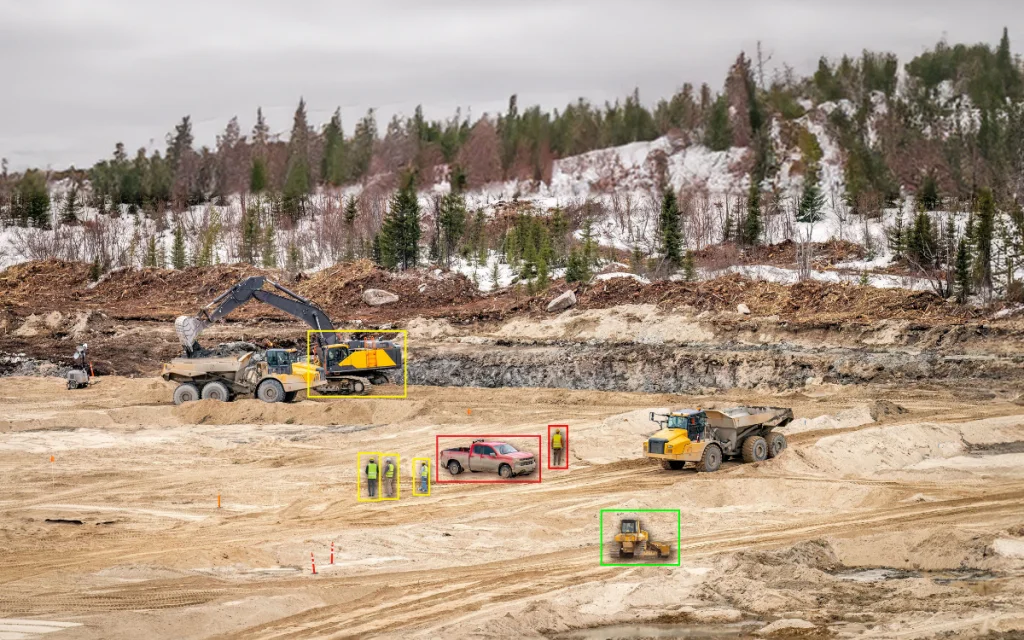
A persistent challenge in construction is the dynamic nature of crews and subcontractors, making it impractical to always rely solely on personal wearable safety devices. Instead, camera-based detection offers a realistic solution that “sees” people and obstacles in real time and can be configured to alert only when a person intrudes into a defined risk zone (reducing nuisance alarms). Without requiring on-site crew members to be constrained by physical devices, operators can maintain situational awareness and respond to genuine hazards more effectively.
References
- NIOSH. (2023). National Stand Down to Prevent Struck by Incidents. Centers for Disease Control and Prevention. https://blogs.cdc.gov/niosh-science-blog/2023/04/04/2023-struck-by-stand-down/
- Centers for Disease Control and Prevention. (2019). Construction Vehicle Struck by Deaths. CDC Stacks. https://stacks.cdc.gov/view/cdc/226392
- Occupational Safety and Health Administration. (n.d.). The Business Case for Safety: Benefits. https://www.osha.gov/businesscase/benefits
- Occupational Safety and Health Administration. (n.d.). Penalties. https://www.osha.gov/penalties
Read the full article at www.ohsonline.com.