
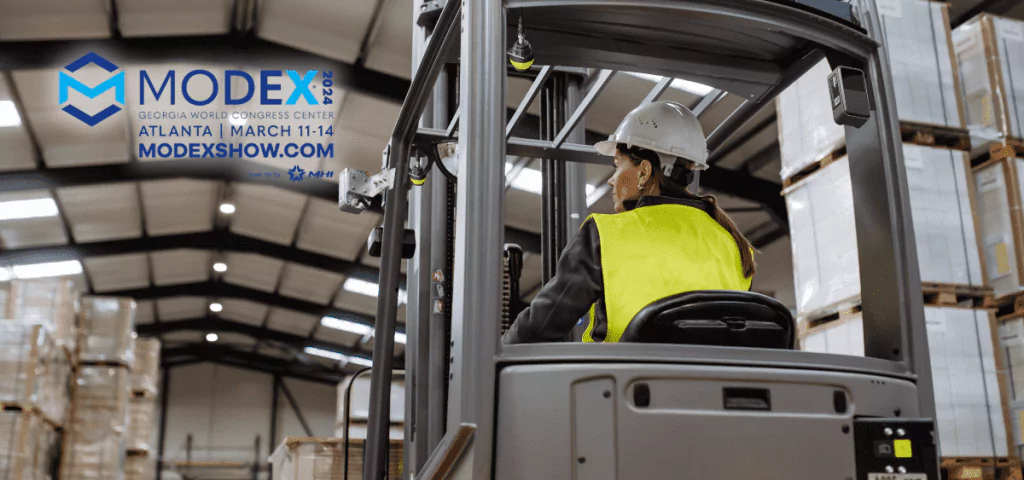
As workers and machinery increasingly interact in the material handling world, the risk of pedestrian collisions and SIFs (serious injury or fatality) have become a critical concern for safety departments. Brian Jones, Matrix VP of Marketing, and Derrick Bennett, Product Manager, will discuss the development and implementation of advanced collision avoidance technologies.
These systems use sophisticated cameras and artificial intelligence (AI) to detect and mitigate potential collisions between pedestrians and mobile equipment like forklifts. Their presentation discusses the effectiveness of such systems in preventing accidents and improving overall workplace safety. Additionally, this presentation highlights the potential for future advancements and integration of AI in refining pedestrian collision avoidance strategies.
Please join them on Tuesday, March 12 at 1:30 PM EST at the MODEX Transportation and Logistics Theater.
Matrix will be exhibiting OmniPro Vision AI at MODEX 2024 in Booth C4471.
Takeaways From the MODEX Floor:
Understanding Today’s Pedestrian Collision Avoidance Technologies
During the MODEX 2024 session, Brian Jones and Derrick Bennett discussed the current collision avoidance landscape and how organizations can evaluate technologies based on their operating environment. The presentation covered AI cameras, radar, LiDAR, ultrasonic sensors, GPS, ultra-wideband (UWB), and electromagnetic detection systems, highlighting that each technology offers unique strengths and limitations. Attendees are encouraged to look beyond individual features and consider how technologies can scale and evolve as operational needs change.
Moving from Collision Warnings to True Collision Avoidance
The presentation outlined the progression of safety technology from basic visual warnings to advanced automated controls. This framework included collision warning systems, collision avoidance systems, sensor fusion, and ultimately automation. By combining multiple sensor technologies and equipment controls, organizations can move beyond simply alerting operators to actively helping reduce risk when pedestrians and mobile equipment interact.
The discussion emphasized that collision avoidance should be viewed as part of a broader engineering control strategy focused on reducing serious injuries and fatalities in industrial environments.
Key Considerations When Evaluating Safety Technology
One of the primary takeaways from the session was the importance of defining the specific safety challenge before selecting a solution. Speakers highlighted factors such as operational environment, technology type, system functionality, performance benchmarking, integration capabilities, future development, and ongoing support.
Organizations were encouraged to establish clear evaluation criteria, involve key stakeholders early, and pilot solutions in the areas where risk actually occurs. The presentation concluded that successful deployments depend on selecting technology that fits the environment, prioritizing core functionality, and partnering with providers capable of supporting long-term operational success.